
Enabling Real-Time Antibody–Cell Avidity Analysis with the Hamilton PSD/4

OEM Integration Story
Inside CellVysion: How the Hamilton PSD/4 Powers Advanced SPR Imaging
CellVysion is a surface plasmon resonance imaging (SPRi) platform developed to quantify antibody-cell avidity in real time under physiological flow conditions. But its story is really about a collaboration: CellVysion was developed with the Hamilton PSD/4, our precision syringe pump, at its core.
Unlike conventional assays that primarily measure molecular affinity, CellVysion measures the combined strength of multiple receptor-ligand interactions between living cells and immobilized ligands, providing a more biologically relevant assessment of therapeutic antibodies and cell-based therapeutics. That measurement only works when fluid delivery is exact and repeatable, which is precisely the problem the PSD/4 was built to solve.
1. Scientific Workflow
The CellVysion workflow begins with calibration and generation of a continuous ligand density gradient on a sensor chip. Cells are then introduced into the flow channel where they sediment and interact with the immobilized ligand under controlled conditions. After cell binding, a precisely controlled flow is applied to create shear forces that challenge the cell-surface interaction. Along the ligand gradient, a characteristic tipping point is observed where adhesive forces and detachment forces are balanced. This tipping point is used to quantify cell-antibody avidity.
The CellVysion software subsequently converts the measured tipping point into quantitative avidity metrics, enabling direct comparison between antibody candidates, cell populations, or therapeutic formats such as bispecific antibodies and CAR-T related constructs.

2. How the Hamilton PSD/4 is Integrated into the CellVysion Fluidic Architecture
At the center of CellVysion's fluidics is the Hamilton PSD/4 precision syringe pump, a programmable syringe drive capable of highly accurate aspiration, dispensing, dilution, mixing and flow control. The PSD/4 combines a precision syringe with a multiport valve, allowing software-controlled routing of fluids from multiple reservoirs into the CellVysion flow cell.
3. Fluid Handling Operations Performed by the PSD/4
The PSD/4 supports virtually all critical liquid-handling functions within CellVysion, including:
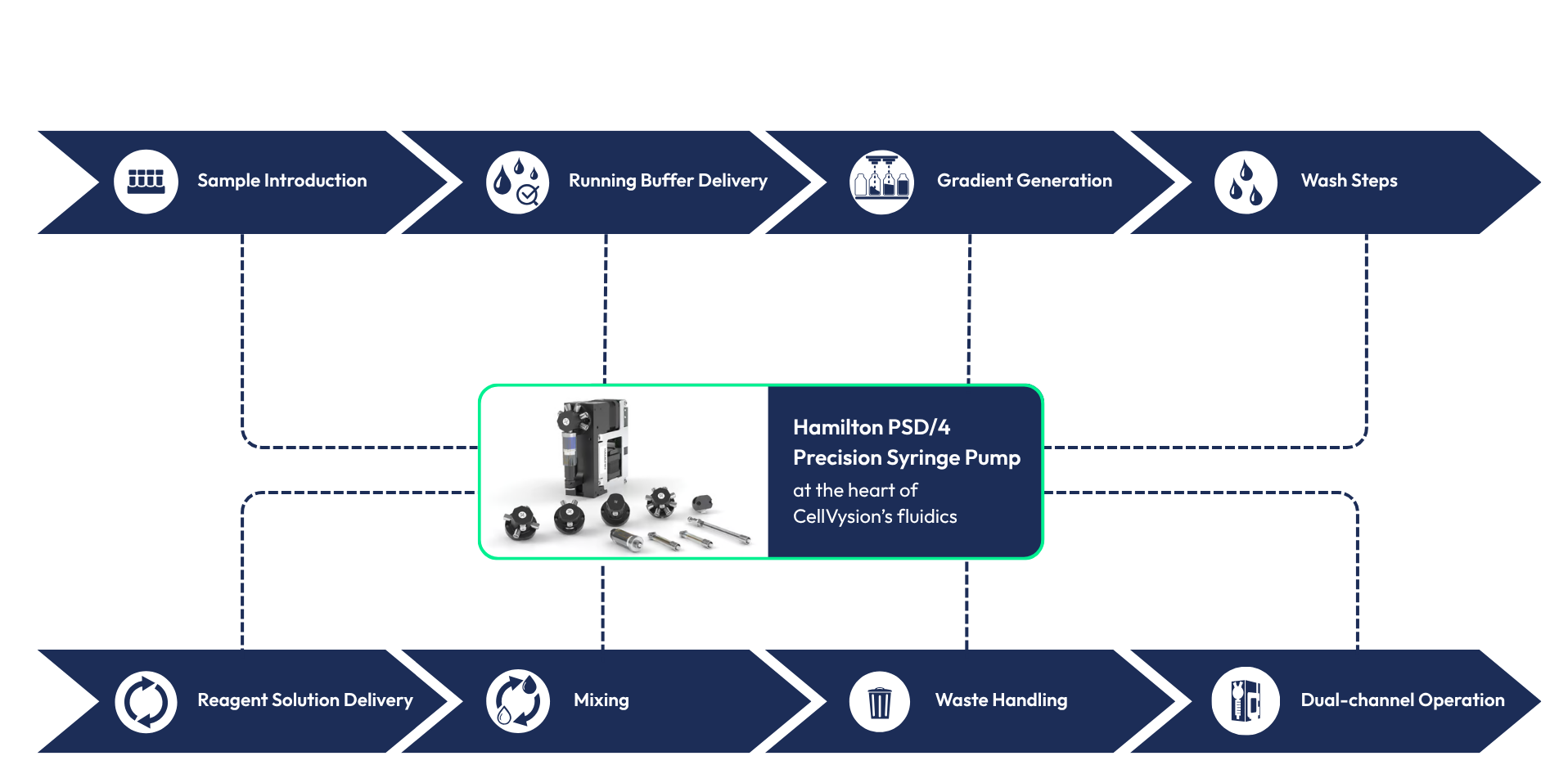
Sample introduction: accurate injection of cells, antibodies, or other biological samples into the measurement chamber.
Running buffer delivery: continuous and pulse-controlled delivery of physiological buffers during measurements.
Gradient generation: controlled introduction and mixing of reagents required for generating the continuous ligand-density gradient on the sensor surface.
Wash steps: removal of unbound cells and excess reagents.
Regeneration solution delivery: controlled exposure of the sensor surface to regeneration reagents between runs.
Mixing: buffer and sample can for example be mixed at different ratios.
Waste handling: routing of used samples and reagents to waste collection.
- Dual-channel operation: synchronized and programmable flow control across the CellVysion two-channel fluidic architecture, allowing efficient experimental design and comparison studies.
4. Why Precise and Programmable Fluid Handling is Critical
Several aspects of the CellVysion measurement principle rely heavily on precise fluid control:
- Generation of reproducible ligand gradients.
- Controlled cell sedimentation and binding conditions.
- Application of defined shear forces during avidity determination.
- Stable physiological environments throughout measurements.
- High reproducibility between experiments and operators.
Small deviations in flow rate or injected volume could alter ligand density, cell exposure, or detachment forces, directly affecting the measured avidity. The PSD/4's high positional resolution and programmable flow profiles therefore contribute directly to measurement accuracy and scientific reliability.
5. Scientific Highlights
From a scientific perspective, the most important innovation is that CellVysion measures functional cellular binding strength rather than only molecular affinity. The system captures the cumulative effect of receptor density, antibody affinity, receptor organization, multivalency, and cellular heterogeneity in a single experiment. This better reflects biological reality than many traditional binding assays.
6. What Challenge Does CellVysion Solve?
Researchers developing biologics often face the challenge that promising candidates show excellent affinity in conventional assays, but fail to perform as expected in cellular or clinical settings. CellVysion addresses this gap by providing direct measurements of cell-antibody avidity under near-physiological conditions, allowing more informed lead selection earlier in development.
7. Why Measuring Antibody-Cell Avidity Under Physiological Conditions Matters
In vivo, therapeutic antibodies operate in a dynamic environment where cells experience fluid flow, multivalent interactions, and complex receptor distributions. Measuring only affinity does not fully predict biological performance. CellVysion reproduces these conditions more closely by combining living cells, controlled flow, and real-time detection, generating data that better reflects therapeutic functionality and potential clinical efficacy.

8. Future Impact in Biologics and Cell-Based Research
CellVysion is expected to have the greatest impact in:
- Antibody lead selection and optimization.
- Bispecific antibody development.
- Immuno-oncology and CAR-T/NK-cell therapies.
- Target validation and biomarker characterization.
- Cell-surface receptor biology.
- Cell therapy development and functional immune-cell profiling.
By providing quantitative avidity measurements that cannot be obtained with traditional affinity assays alone, CellVysion can help improve candidate selection, reduce development risk, and increase the likelihood that preclinical findings translate into clinical success.
Authored in collaboration with our valued partner
