Stability and Accuracy of DuraCal pH Buffers
Questions often come up regarding pH buffers, their stability (shelf life), and impact on accuracy. This knowledgebase article takes on many of these topics.

How are Hamilton Buffers Different?
pH and ORP liquid buffer solutions can easily be overlooked when it comes to maintaining measurement accuracy. Hamilton DuraCal pH buffers mitigate these risk of calibration errors through innovative formulation and bottle design. The video below provides a brief introduction about how Hamilton buffers are different.
/
How does Hamilton define a pH buffer's stability?
The terms stability and shelf life are often used interchangeably. Stability references the time period during which a pH buffer's published accuracy can be met. Stability for Hamilton DuraCal pH buffer solutions is typically 24 to 60 months (2 to 5 years) before expiration. During this time it is assumed that the pH buffer has remained unopened and unexposed to adverse conditions (Example - excessive temperature).
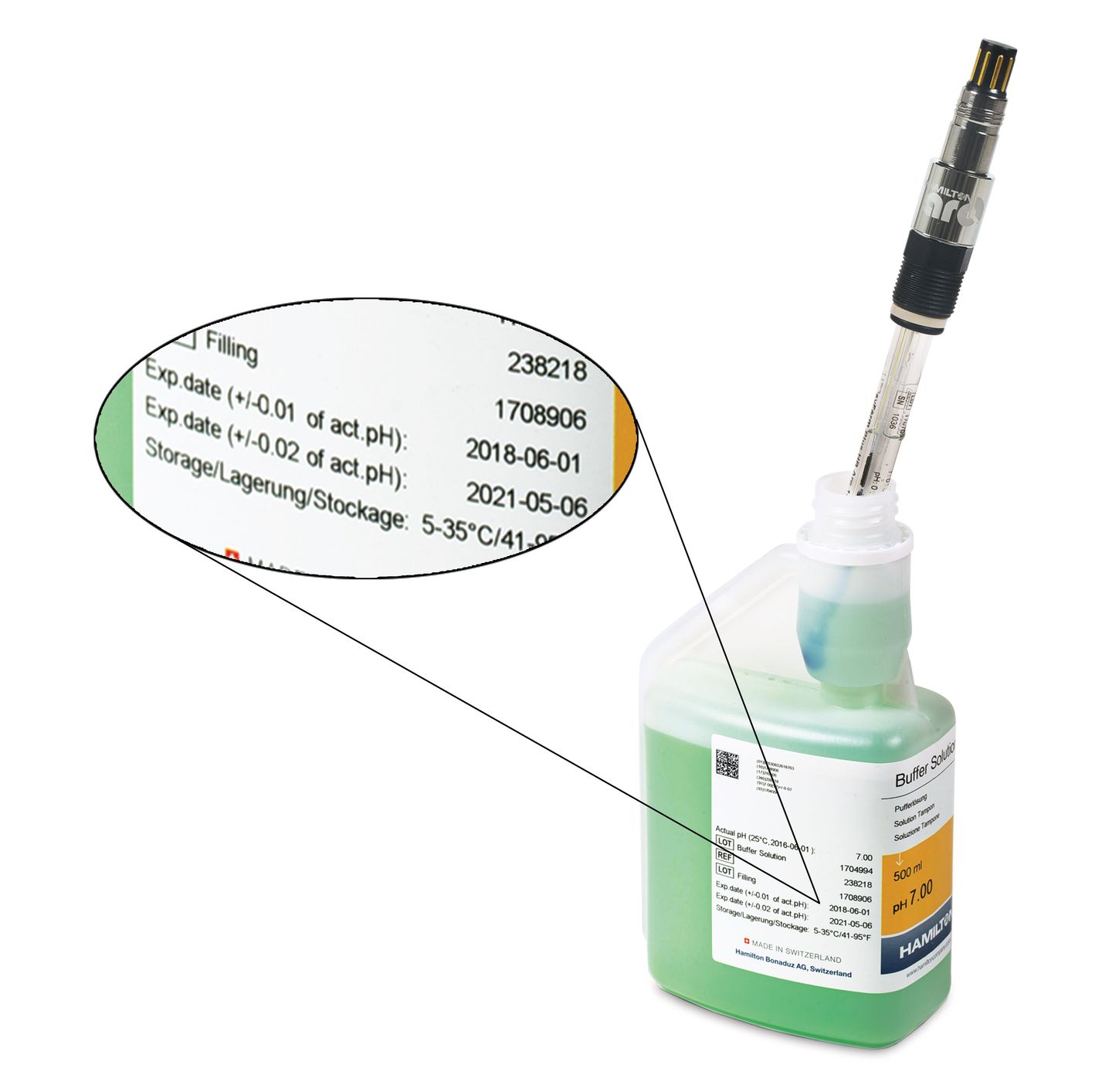
How does Hamilton determine the accuracy of DuraCal pH buffers?
Top-Down Traceability
DuraCal pH buffer solutions are produced in 1000L lots. Hamilton performs comparison testing of individual lots against two secondary reference buffer solutions that have previously been verified against primary reference solutions from PTB or NIST. The actual buffer values and measurement uncertainty for each comparison are documented. This information is included on the Declaration of Quality (DOQ) supplied with all buffer solutions. See examples of the DOQ documents.
Bottom-Up Traceability
4.01, 7.00, 9.21, and 10.01 DuraCal pH buffer solutions all go through additional testing steps. A representative sample of each lot is provided to the independent testing laboratory ZMK. ZMK is approved by the German national accreditation body DAkkS (Deutsche Akkreditierungsstelle) to perform primary and secondary testing of pH buffers. The sample buffer must undergo additional comparison testing using two secondary reference buffer solutions from accredited suppliers of secondary reference materials. pH values are confirmed using a differential potentiometric cell (Baucke cell). The actual pH value of the buffer is recorded on DAkkS calibration certificate which is included with each bottle. These additional testing steps allow these buffer solutions to be identified as Certified Reference Material (CRM).
Hamilton refers to this practice of internal and external testing as "Top-down" and "Bottom-up" traceability. It ensures the highest accuracy for DuraCal buffer solutions.
How does temperature affect DuraCal pH buffers?
The pH buffer value is based on 25°C temperature. Changes in ambient temperature will affect the buffer's pH and should be accounted for during calibration. The label on the bottle provides information for expected pH values based on temperature. For more detailed information, we have published the temperature dependence of each buffer in 1°C increments across all pH buffer solutions.

Is the accuracy affected once the pH buffer is opened?
Hamilton DuraCal pH buffers will maintain their published accuracy (±0.01pH or ±0.02pH) during their expiry period of 2 years or 5 years, even after the bottle has been opened to air.
Please note that this assumes that good laboratory practices are followed. Exposure to dust or other external contaminants should be avoided. If using glassware for calibration, then both the glassware and the sensor should be properly cleaned prior to use. Hamilton offers a Cleaning Solution Set (Ref 238290) specifically designed for this purpose. After cleaning, a final rinse with deionized water should be applied to avoid contamination of the buffer solution.
Using the Calpak buffer bottle
The Calpak bottle is specifically designed to avoid contamination issues. A light squeeze of the bottle allows fresh buffer solution to flow into the specially designed calibration chamber at the top of the bottle. A one-way valve separates the chamber from the buffer below. This design prevents users from recycling buffer back into the bottle, as well as limits any contamination from the sensor reaching the fresh buffer in the bottle below. Additionally, calibration can now be performed within the chamber without the need for a separate beaker (further removing contamination risk). Calpak bottles are used for 250 and 500mL DuraCal buffer solutions.

Related Content
- Download our Liquid Solutions Brochure to see the entire pH buffer product offering.
- Visit our Main pH Knowledge Base Article Page to see all articles on pH sensors.