Investigating the Neural Basis of Emotional States in Honey Bees
Precise microinjections using Hamilton microliter syringes to investigate how neuromodulators influence judgment bias and emotional state processing in honey bees.

DATE: June 2026
Centre des Sciences du Goût et de l'Alimentation | Biology Department | Lea Droesbeke Fuente, PhD Student
The way we perceive the world is never truly neutral. Our emotional state shapes how we interpret ambiguous information: when we feel positive, we tend to judge ambiguity optimistically; when negative, pessimistically. This phenomenon, known as judgement bias, has been observed across a wide range of animal species, where it serves as a valuable tool for probing emotional states. The 2024 New York Declaration on Animal Consciousness formally acknowledged a realistic possibility of conscious experience in insects. Yet our understanding of emotional states in invertebrates remains in its early stages.
Bees were the first invertebrate in which judgment bias was demonstrated yet what happens in their brain when they do remains a mystery. The aim of my project is to identify the neurophysiological foundations of judgment bias in the domestic honey bee Apis mellifera. Specifically, I will investigate how positive and negative experiences influence bees' interpretation of ambiguous stimuli.
Currently, I am using the well established differential olfactory conditioning paradigm, in which bees are trained to associate one odorant (A) with a reward and anot her (B) with a punishment. Following learning, bees will be exposed to either a positive or negative experience an unexpected reward or an uncomfortable shaking experience and their response to an ambiguous mixture (AB) will be.
To investigate the neural circuits underlying judgment bias, I will combine this behavioural paradigm with a pharmacological approach by injecting agonists and antagonists of the main neuromodulatory systems dopamine, octopamine, and serotonin directly into specific bee brain areas. Given the miniaturised scale of the insect brain, this approach demands sub microliter precision and perfect reproducibility across individuals. Hamilton microsyringes provide the submicroliter accuracy required by this technically deman ding procedure.
By uncovering the neuromodulatory basis of judgment bias in bees, this project aims to shed light on the neural foundations of emotional states in invertebrates a question that is both scientifically compelling and increasingly relevant to their welfare.
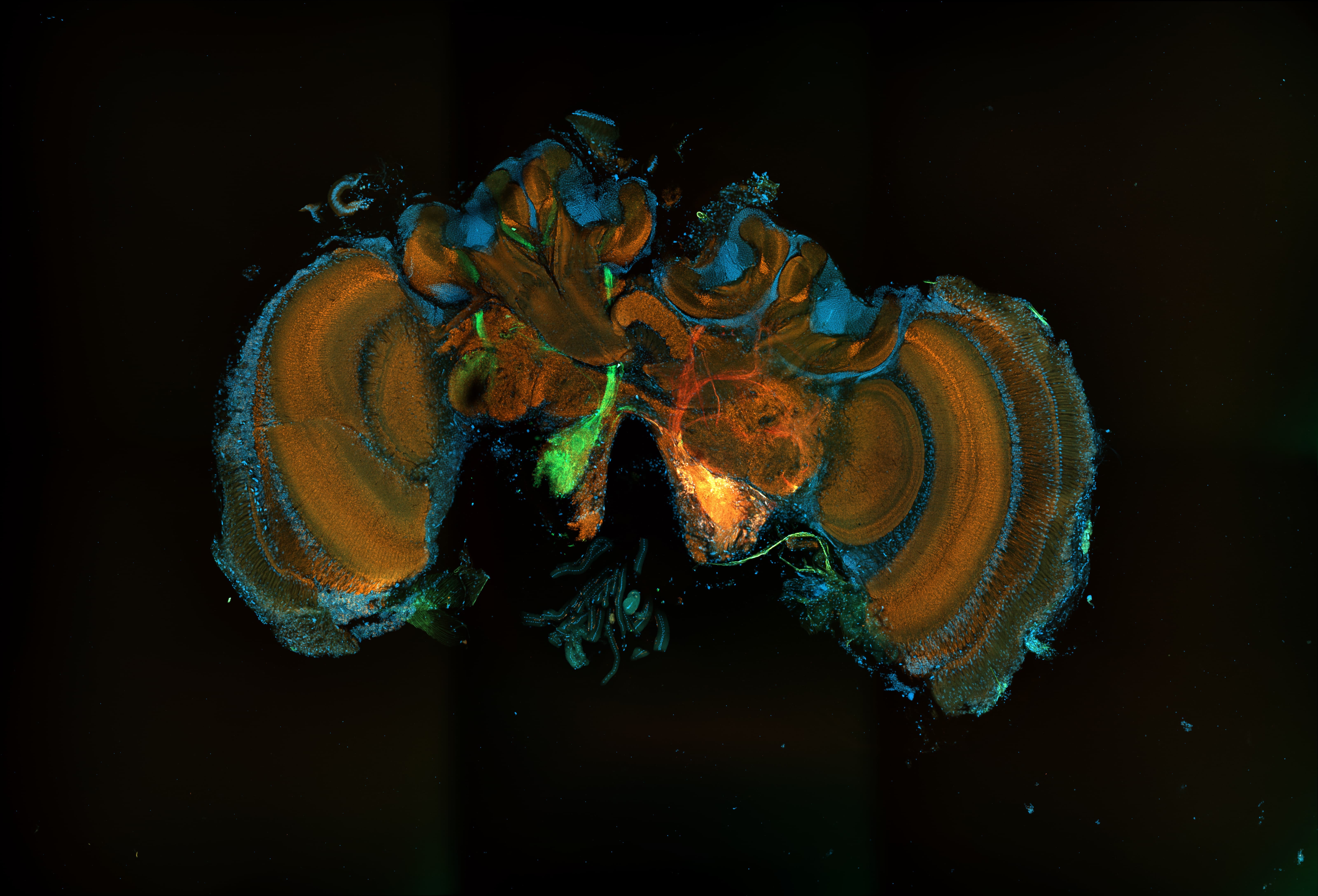
Figure 1 | Multichannel fluorescent micrograph of the honeybee brain and mapping of the neural projections of olfactory projection neurons in domestic honey bee Apis mellifera.
Apply for a Hamilton Syringe Grant Today
Help Us Spread the Word
Know someone who could benefit from this grant? Help us support research and higher education by sharing this page on social media.


Backed by world-class service and support.
For over 75 years, the Hamilton name has been recognized globally for its unwavering commitment to quality. That pledge extends to creating long-term customer partnerships. We're proud to offer in-depth training courses, on-site field support, custom product builds, and so much more.
Let's Talk
Connect with a Hamilton expert to discuss solutions for your workflow. We are here to enable your success.
Request Type: