Using Stereotaxic Viral Injections to Study Tauopathy-Induced Hippocampal Dysfunction
Precise stereotaxic viral injections using Hamilton Neuros syringes to investigate Tau-induced hippocampal dysfunction and early tauopathy mechanisms.

DATE: June 2026
University of Castilla-La Mancha | Neurophysiology and Behaviour Laboratory | Rodrigo Díaz-Muñoz, PhD Student
As a PhD student at the Neurophysiology and Behaviour Laboratory at University of Castilla-La Mancha (Spain), my work focuses on understanding how pathological forms of Tau disrupt hippocampal circuits during the early stages of tauopathies.
Our research combines viral vector technology, behavioral neuroscience, electrophysiology, and histology to investigate how Tau pathology alters neuronal communication and ultimately impairs memory. Using AAV-mediated expression of different human Tau variants in CA1 region of the hippocampus, we have recently demonstrated that pathological Tau induces significant spatial memory deficits, disrupts hippocampal oscillatory activity, promotes synaptic dysfunction, and generates distinct forms of network impairment. These findings are helping us identify the earliest functional changes that occur before extensive neurodegeneration develops.
The Hamilton Neuros syringe will be used for stereotaxic intracerebral injections of viral vectors into highly specific hippocampal subregions. Precise and reproducible delivery is essential for generating reliable models of tauopathy, as even small differences in injection location or volume can significantly affect pathology development and experimental outcomes. By incorporating Hamilton products into our workflow, we will be able to continue producing robust and reproducible data while expanding our studies on the mechanisms linking Tau pathology, neuronal hyperexcitability, synaptic dysfunction, and cognitive deficits.
Beyond its scientific impact, this grant will also support the training of undergraduate students, master’s students, and future PhD candidates. Young researchers joining our laboratory will learn stereotaxic surgery, viral vector delivery, and experimental neuroscience techniques using professional equipment, helping them develop the technical skills required for future careers in biomedical research.
The goal of our laboratory is not only to advance our understanding of Alzheimer’s disease, but also to train the next generation of neuroscientists. Support from Hamilton would contribute directly to both missions by enabling cutting-edge research and enhance scientific excellence among emerging researchers.
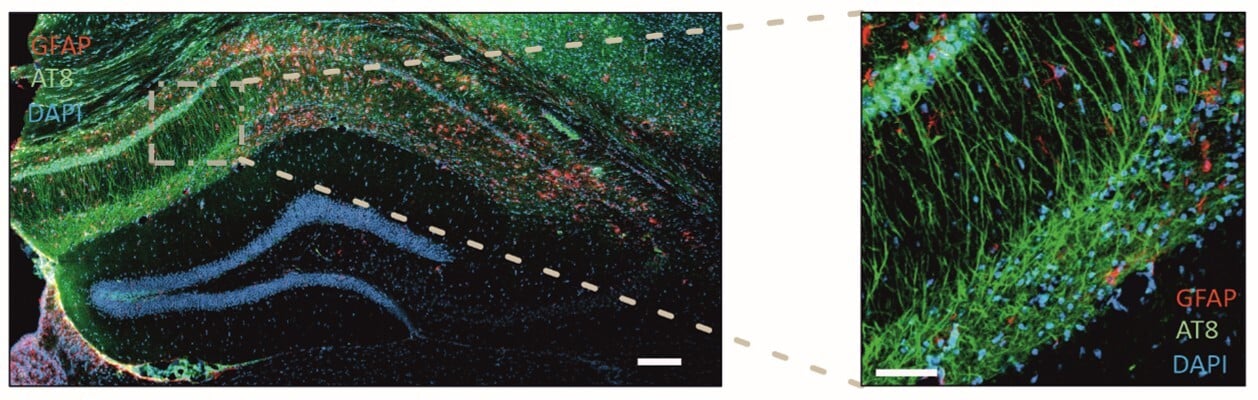
Figure 1 | Representative AT8 and GFAP confocal immunostaining following bilateral stereotaxic AAV delivery into dorsal CA1, demonstrating robust localized phospho-tau pathology within the targeted hippocampal region.
Apply for a Hamilton Syringe Grant Today
Help Us Spread the Word
Know someone who could benefit from this grant? Help us support research and higher education by sharing this page on social media.


Backed by world-class service and support.
For over 75 years, the Hamilton name has been recognized globally for its unwavering commitment to quality. That pledge extends to creating long-term customer partnerships. We're proud to offer in-depth training courses, on-site field support, custom product builds, and so much more.
Let's Talk
Connect with a Hamilton expert to discuss solutions for your workflow. We are here to enable your success.
Request Type: