Henry’s Law
The oxygen concentration in any liquid depends on the solubility of oxygen in that liquid and is proportional to the partial pressure of oxygen. The conversion from partial pressure to concentration is possible with the aid of the principles defined in Henry’s law.
The British physician and chemist William Henry (1775–1836) stated in 1803 that:

Henry’s Law describes how many liters of a gas dissolve in 1 liter of water at a certain temperature and a partial pressure of P:

where S is the solubility of the gas (by volume), P is the partial pressure of the gas, PN is the atmospheric pressure (1 atm or 101.3 kPa at sea level), and α is a dimensionless absorption coefficient.
In the case of air-saturated water, the partial pressure of oxygen for water-saturated air must be substituted for P. The absorption coefficient α is different for every liquid (see illustration); therefore, different solutions have a different dissolved oxygen concentration at the same partial pressure of oxygen.
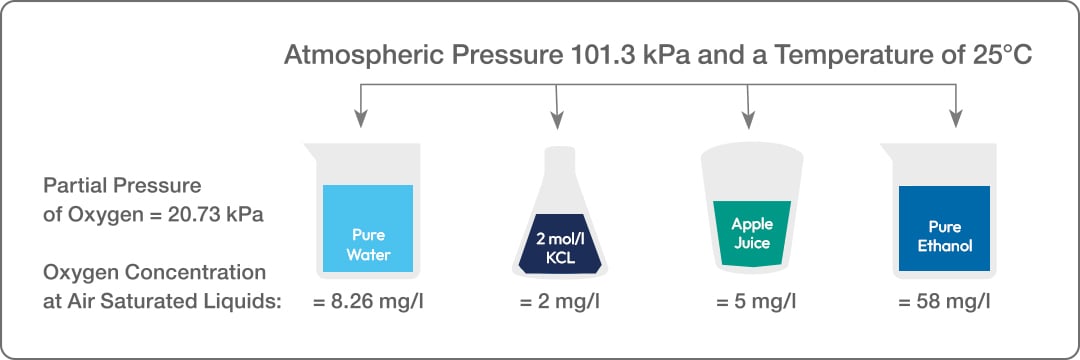
Oxygen concentration in different air-saturated liquids.
Note that the absorption coefficient α is also temperature dependent, as shown in the table below.
Absorption Coefficient Values for Oxygen in Water
°C | 0 | 5 | 10 | 15 | 20 | 25 | 30 | 35 | 40 | 50 |
|---|---|---|---|---|---|---|---|---|---|---|
α | 48.90 | 42.86 | 38.02 | 34.15 | 31.03 | 28.44 | 26.16 | 24.40 | 23.06 | 20.90 |
With Henry’s Law and the molar mass (MO2) and molar volume (VO2) of oxygen, it is possible to calculate the saturated oxygen concentration (g/l) in air-saturated water (water in equilibrium with air):
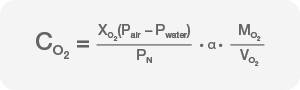
Where:
CO2 = saturated oxygen concentration (g/l)
XO2 = 0.2095 (dimensionless)
Pair = total atmospheric pressure (kPa)
Pwater = partial water vapor pressure (kPa)
PN = atmospheric pressure (kPa)
α = absorption coefficient for water (dimensionless)
MO2 = molar mass of oxygen (32 g/lmol)
VO2 = molar volume of oxygen (22.414 l/mol)
The values of the saturated oxygen concentration at different temperatures and different pressures play an important role for the calibration of DO analyzers. Therefore, these values are combined in the saturated oxygen concentration tables. Also note that salinity can influence the solubility of the liquid thus must be considered when discussing oxygen concentration.

Download Our O2 Measurement Guide
Get a better understanding of O2 measurement in Hamilton’s comprehensive O2 Measurement Guide.