The pH Scale
Understanding the pH scale is the first step to understanding the basic theory of how pH measurement works. This article discusses the fundamentals of the pH scale, concept of hydrogen ion concentration and how it relates to the pH measurement scale.

What is the pH scale?
The pH scale is a logarithmic scale that expresses the active concentration of the H+ ions, and therefore, the pH unit of measure is defined as the negative common logarithm of the active hydrogen ion concentration in an aqueous solution. Each unit change represents a tenfold difference in hydrogen ion activity. The following formula defines it:
pH = –log[H⁺]
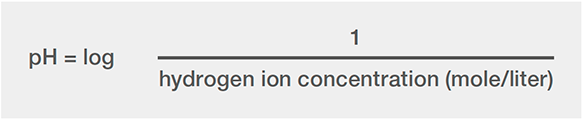
This means a solution with a hydrogen ion concentration of 1×10⁻⁷ mol/L has a pH of 7. A higher H⁺ concentration results in a lower pH, indicating greater acidity.
In concentrated solutions such as hydrochloric acid (HCl), the H⁺ and Cl⁻ ions are packed closely together. This crowding causes the ions to interfere with each other’s movement, reducing their effective activity, even if their actual concentration remains high. As a result, the measured pH, which reflects ion activity, may no longer match the calculated value based on total concentration. This distinction becomes increasingly important when dealing with strong acids or bases, where ion interactions are more pronounced.

It is important to recognize the fact that a pH measurement determines only the concentration of active hydrogen ions in a solution, and not the total concentration of hydrogen ions. It is this factor that is responsible for the observed pH change in pure water with temperature.
pH Scale Range
| pH Value | Type of Solution |
|---|---|
| 0–3 | Strong Acid |
| 4–6 | Weak Acid |
| 7 | Neutral |
| 8–10 | Weak Base |
| 11–14 | Strong Base |
How does pH relate to Hydrogen Ion Concentration?
If we express the hydrogen ion concentration of an aqueous solution in relation to its molecular value we derive a scale of 1 (100) via 10-7 to 10-14 mole/litre. This scale is impractical but if written as a function of its negative logarithm a real and simple scale of 0–14 has been created: the pH scale.
| H+ Concentration (mole/litre) | OH- Concentration (mole/litre) | pH |
|---|---|---|
| 1 | 0.00000000000001 | 0 |
| 0.1 | 0.0000000000001 | 1 |
| 0.01 | 0.000000000001 | 2 |
| 0.001 | 0.00000000001 | 3 |
| 0.0001 | 0.0000000001 | 4 |
| 0.00001 | 0.000000001 | 5 |
| 0.000001 | 0.00000001 | 6 |
| 0.0000001 | 0.0000001 | 7 |
| 0.00000001 | 0.000001 | 8 |
| 0.000000001 | 0.00001 | 9 |
| 0.0000000001 | 0.0001 | 10 |
| 0.00000000001 | 0.001 | 11 |
| 0.000000000001 | 0.01 | 12 |
| 0.0000000000001 | 0.1 | 13 |
| 0.00000000000001 | 1 | 14 |
The Effect of Temperature on pH
If the temperature rises in pure water, the dissociation of hydrogen and hydroxyl ions increases. Since pH is related to the concentration of dissociated hydrogen ions alone, the pH value actually decreases although the water is still neutral. Therefore it is very important that we know the relationship between the dissociation constant and temperature, otherwise it is not possible to predict the pH value of a solution at a desired temperature from a known pH reading at some other temperature.
This is best explained if we compare the concentration of 1 mol/l pure hydrochloric acid (HCl) which has a pH value of 0, with a concentration of 1 mol/l pure sodium hydroxide (NaOH) which has a pH value of 14. When both solutions are mixed in same quantities, a neutralization reaction occurs as may be seen by the following equation:
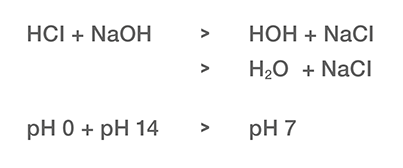
The acidic and alkaline properties of the solutions are lost because of the union of the hydrogen and hydroxyl ions which form water. The newly formed sodium chloride (table salt) does not influence the pH value.
Generally the following can be stated:
- If the concentration of active hydrogen and active hydroxyl ions in a solution is of the same quantity, the solution is neutral (pH value = 7)
- If the solution has a higher concentration of active hydrogen ions than that of hydroxyl ions, the solution is an acid ( pH value below 7)
- If the solution has a higher concentration of active hydroxyl ions than that of hydrogen ions, the solution is a base (pH value above 7)
The graph below provides another way to view the pH scale along with the pH values of some more common liquids.

pH in Biopharmaceutical Applications
In biopharma applications, pH plays a critical role in:
- Cell culture: Viability and growth depend on narrow pH ranges
- Chromatography: Buffer pH affects binding and elution efficiency
- Protein stability: Enzyme activity and folding are pH-sensitive
- Formulation: pH impacts drug solubility and shelf life
A small pH shift can significantly impact product yield, purity, and stability, which is why precise control and monitoring of pH is essential across development and production stages.

Download Our pH Measurement Guide
Get a better understanding of pH measurement in Hamilton’s comprehensive pH Measurement Guide.