Composition of the Atmosphere
The air in the atmosphere is a mixture of gases, water vapor, and minute solids and liquid particles in suspension. The bulk of the lower atmosphere (0 to 100 km) is composed mainly of N2 and O2, with a relative abundance of 0.78 N2 and 0.21 O2, based on the average number of molecules present in a representative volume of air.
The mass of a hypothetical mean molecule of air of the lower atmosphere is 28.97 grams per mole. This value is intermediate between that of N2 (28) and that of O2 (32). The value reflects the presence of trace quantities of water, argon, carbon dioxide, and other less abundant compounds that form the mixture of air (see Table).
Gases Found in the Atmosphere
| Species | Name | Relative Abundance (ppb by volume)* | Source |
|---|---|---|---|
| N2 | Nitrogen | 7.81 x 10⁸ | Biologic |
| O2 | Oxygen | 2.09 x 10⁸ | Biologic |
| H2O | Water | 106 x 107 | Physical |
| Ar | Argon | 9.34 x 10⁶ | Radiogenic |
| CO2 | Carbon-Dioxide | 3.5 x 10⁵ | Biologic/Industrial |
| Ne | Neon | 1.8 x 10⁴ | Interior |
| He | Helium | 5.2 x 10³ | Radiogenic |
| CH4 | Methane | 1.6 x 10³ | Biologic |
| Kr | Krypton | 1.0 x 10³ | Interior |
| H2 | Hydrogen | 5.0 x 10² | Biologic/Photochem. |
| N2O | Nitrous-Oxide | 3.0 x 10² | Biologic/Industrial |
| CO | Carbon-Monoxide | 1.0 x 10² | Photochem./Industrial |
| SO2 | Sulfur-Dioxide | <102 | Industrial/Photochem. |
| O3 | Ozone | <102 | Photochem. |
| Xe | Xenon | 9 x 101 | Interior |
| NO | Nitric-Oxide | Variable | Industrial/Biologic |
| NO2 | Nitrogen-Dioxide | Variable | Industrial/Biologic |
| NOx | Nitrous-gases | Variable | Industrial/Biologic |
| CH3Cl | Methyl-Chloride | 6.0 x 10⁻¹ | Biologic |
| CCl2F2 | Halogenated-Methane | 2.9 x 10⁻¹ | Industrial |
| CCl3F | Halogenated-Methane | 1.7 x 10⁻¹ | Industrial |
| CCl4 | Carbon-Tetrachloride | 1.2 x 10⁻¹ | Industrial |
| CH3CCl3 | Methyl-Chloroform | 9.8 x 10⁻² | Industrial |
| CF4 | Carbon-Fluoride | 7.0 x 10⁻² | Industrial |
| CH3Br | Methyl-Bromide | 1.0 x 10⁻² | Biologic/Industrial |
* ppb = part per billion
The composition of the atmosphere is measured by its mean density (the average mass per unit volume). As it can be seen, the mean density of air (28.97 g/mol) does not change significantly from the Earth’s surface to a height of about 100 km. Thereafter it declines gradually down to less than 3 g/mol at a height of 1000 km.
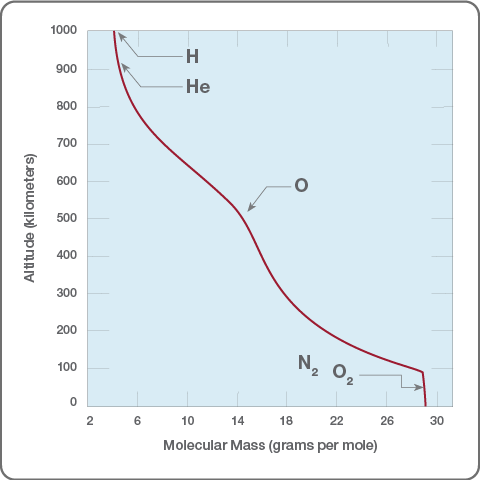
Average molecular mass of the atmosphere in atomic units.
The approximate uniformity in the first 100 km of height above the Earth’s surface results from molecular motion and the high frequency with which molecules of a particular species are involved in collisions with their neighbors. For instance, an O2 molecule encounters a N2 molecule on average once every 10−9 seconds near the Earth’s surface. At 100 km altitude, the encounter time is reduced to about 10−3 seconds. Because of their molecular masses, molecules experience the force of gravity. Heavy gases are attracted more closely to the Earth’s surface, whereas lighter gases are free to float higher. Oxygen gives way to helium above 600 km, and hydrogen is the major constituent at altitudes higher than 1000 km.

Download Our O2 Measurement Guide
Get a better understanding of O2 measurement in Hamilton’s comprehensive O2 Measurement Guide.